
I spoke of this a few days ago on Tumblr, but it merits mention here: I recently attempted to post on r/otomegames regarding the human-translated Angelique patch - I'd discussed the project on the subreddit previously, and some folks had asked for an update - but my post was removed, labeled as "self-promotion." I messaged the mods for clarification, as my previous discussions hadn't run afoul of this problem and no such rule was evidently being enforced against the AI patch, but received no response.
I don't know if there's been a rule change or if some mod has an odd interpretation of the rules or if someone's just an AI hardliner, but the upshot is that updates on the patch project are likely not going to be forthcoming on that subreddit. I've been posting updates under the "translation project" tag on my Tumblr, so that's the best place for the latest info. I'd also recommend that if you're following any human-powered translation, coding, or patch projects on that subreddit (as it was, previously, a magnet for that activity), follow the creators instead on their social media or blog, or reach out and ask if there's another venue where they're providing updates - just in case they're encountering this resistance as well.
Now, I see there's a bit of a conversation going on with several other untranslated games with human translations in progress having low-effort, straight-from-AI patches released for them. I wanted to wait until my own project was done to comment, but given there is a lot of talk currently, I'll add my own experience. This ran a bit long, so I'll put it under a cut.
A kind person alerted me this evening on Tumblr. The creator of the patch seems to be picking dating sims at random and feeding them into AI translation, seemingly producing one patch a day. I am, uh, not exactly intimidated by this approach.
I've given a further response in that Tumblr post, but just to reiterate: this doesn't change anything for the project. These characters, and this game, deserve a quality translation, and, buddy, if the considerable setbacks that have been copiously detailed in this blog have not deterred me from finishing this project, this certainly won't—not when we're so near the finish line.

Uh, Part Two of my response. Not of the article! Though the article may receive a Part Two someday.
Most assuredly with better font work than my MS Paint image edit.
My apologies for the lateness! My attentions were pulled elsewhere, like to Michael Myers bike flips - and my, the original article has even scrolled off the front page in the meantime. To refresh: the author of Thrilling Tales of Old Video Games noted some parallels between the heroines of Lunar: The Silver Star and Lufia and the Fortress of Doom and speculated, as is the manner of the site, that they were references to an as-of-yet-unidentified predecessor. I mentioned that this was likely the megahit Ys and pointed out the ever-popular and universally-beloved article where I detail Lunar's considerable debt to Ys Book I & II but cautioned that I felt that neither game could be described as a ripoff, as the two titles take their common plot elements in very different directions. I promised to explore this at length in an upcoming article. That article is now.
Spoilers for Lufia and the Fortress of Doom and Lunar: The Silver Star (and all other Silver Star variants) immediately below the cut.
Read more: The very different paths of Lunar and Lufia's heroines

That's Loomis on a bike in the rain. Trust me.
After being lured by the siren song of Jackass bike antics (latest news on that front, from streamer LilithOmen: "I did a backflip on a bike as Loomis into Myers and downed him"), I bit the bullet on Halloween: The Game. Early access and everything, too: I wanted to get in on the ground floor of an asym zeitgeist for once, while the community was still solving the game, before a meta had settled into place.
Well, I gave a good, long chance, about six to seven hours of the survivor experience, and barring some amazing update, I think I'm done with it. I found the game as a whole unsatisfying.
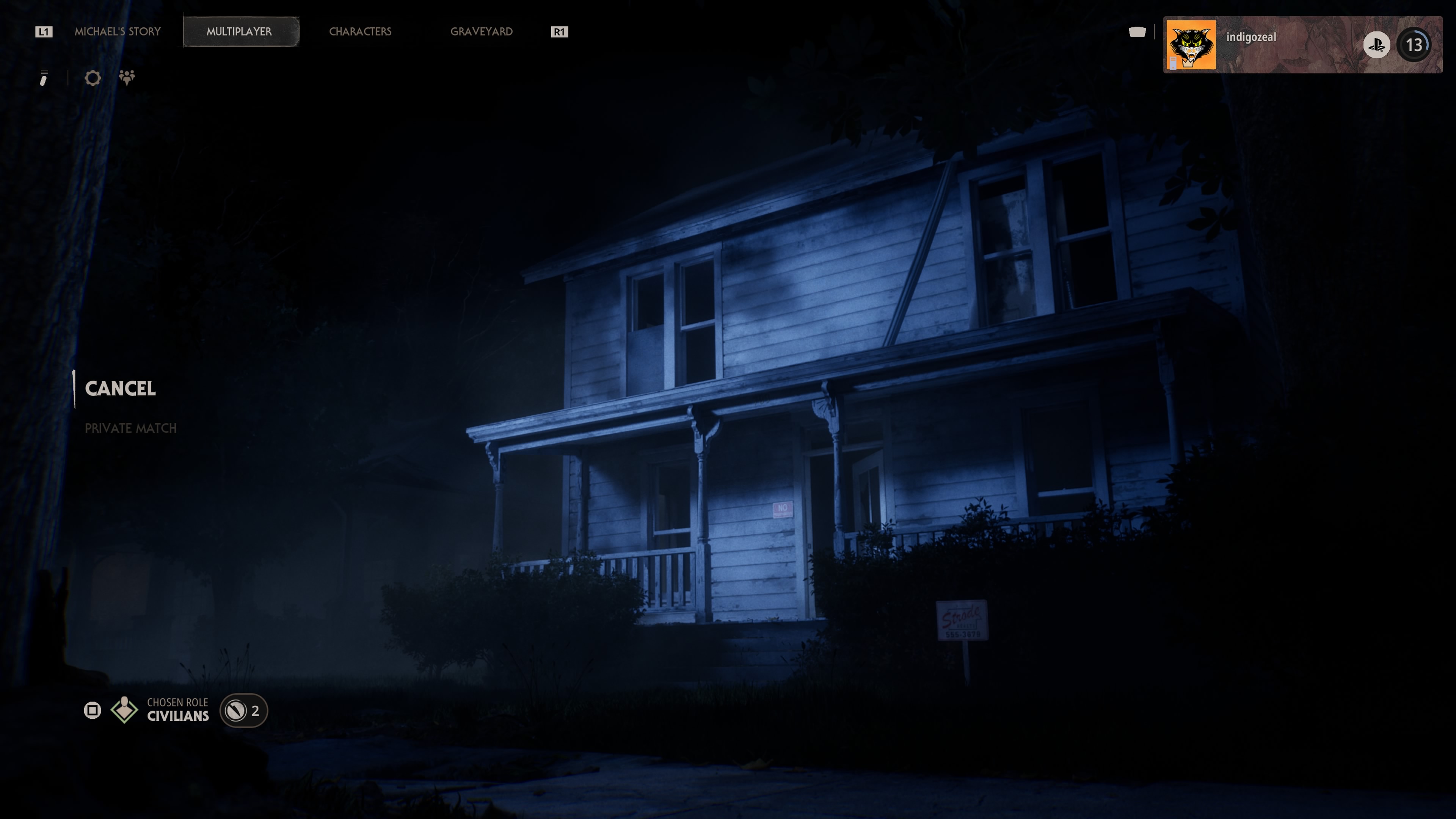
First, a warning: This is a game designed around voice comms. If you, like me, are not a voice comms person, stay away. You can technically play the game, but several mechanics, as detailed below, are much harder than intended without voice communication, and this is, to put it mildly, not designed to be a survivor-sided game in the best of circumstances. You also, to a degree, can't reliably eliminate voice chat; I turned off my mic, turned off microphone transmission & reception in the system settings, but it did not prevent me from hearing chatter sporadically. This could be me being a new PS5 owner and not knowing about some setting or whatnot, but it's sporadic and unpredictable enough where I think a bug is more likely at fault.
Second: While I was drawn to the game in part by the ridiculousness of the bike and the sex minigame, that's kind of it for humor, outside of mechanics involving beer and joints, and the humor there is YMMV depending on how much you find intoxication inherently funny and fascinating. I'll leave my thoughts on that front to James Baldwin:

There is some period-appropriate humor through NPC chatter if you get together an "evil dies tonight" mob (I heard something on a stream about "Farrah Fawcett's hairspray"), but that's one of the voice comm things - you can't have more than two NPCs following you without certain perks, so gathering a posse depends on coordination with other survivors, for which you need voice.

Oh, right - NPCs. That's the other major element that drew me to the game, actually: your primary objective is not to escape yourself, but to find hapless townsfolk and guide them to safety. This is very difficult to do, though: each of the methods of escape from town requires one or more key items (repair tools + a gas can + a key for a car; a fuse + a key or bolt cutters for a gate on the town limits), with only a couple of each item hidden in the cupboards, cabinets, and garages of Haddonfield. You therefore have to engage in a Nickelodeon Finders Keepers search of the map to find these escape items, and having an NPC or two tag along with you during these expeditions is just creating Myers bait. You need instead to find the players and tell them to hide, then come back for them once you have an escape open. Again, though: finding the necessary items can be tough - there are cases where I've spent the entire twenty minutes of a match looking for an item only to come up empty-handed. (The minimap does show you what key items nearby players are carrying, though, suggesting you're meant to team up for the needle-in-a-haystack search - though there's no way of communicating but voice comms.) Even if you succeed in opening an escape, other players may have found and moved the NPCs in the meantime. Coordination with other players helps significantly in all steps of the process - much more even than in, say, Dead by Daylight - which means those dang voice comms.
(In the later stages of my exploits, I took just to completing any stages of the rescue process I could piecemeal - telling any NPCs I found to hide; using any escape items I found on the corresponding escapes if I found them, even if it didn't construct a complete NPC-to-exit pipeline. DbD maven Otzdarva suggests bringing NPCs to the first escape you find and then telling them to hide, but there's no guarantee you'll find the items to get that particular escape open.)

One major problem: despite the presence of several obscure and unfamiliar-to-the-genre mechanics, there is no tutorial for survivor. There is, however, an hour-long single-player killer campaign that serves as an extensive tutorial for Myers. This really widens the disparity between the power role (the killer) and the survivors. This might be intentional - there are many who complain that the killer role in Dead by Daylight isn't as powerful as it should be - but it does make for an extremely frustrating survivor experience. (My plan to have fun figuring out the game alongside everyone else in the release window didn't pan out, as there was just too much, even the very fundamentals, that remained a complete mystery. The entire perk system, for example, is locked behind a tiny, unlabeled prompt on the corner of the screen.) The counter, once again, is to have other players outright tell you stuff via voice comms.
Furthermore, if Myers grabs you when you're alone - and he can, literally, invisibly sneak right up behind you without any music cues or warning, so you're not gonna know this is happening until mid-grab - you die. There's nominally a "struggle free" minigame, but you have to hit a couple buttons about a dozen times, while the Myers player just has to enter a four-button prompt. I've come close several times but have never managed it. If you have a pocket knife or other small blade, you can stab Myers with it for a "get out of jail free" card, though you still have to succeed at a button-mashing game (albeit an easier one). To counter this, the devs in a recent patch made pocket knives etc. rarer, and Myers players have taken to shadow-walking right up next to you and hacking away instead of using the grab & kill; survivors can't recover to run away between weapon blows and can't use the pocket knife escape here, so unless another player's around to attack Michael, you're dead meat at the first blow. It's just not fun to instadie.

So, as I've noted at literally every point I've made so far, much of the game doesn't function as intended on the survivor side without voice comms, to the point where it's almost obligatory - though, as with everything else, the game won't directly tell you that. This isn't, though, a community with which I really want to communicate. My interactions with other survivors usually consisted of someone shoving me and then running off. (The last time someone did this, I tried to retaliate but was, I forgot, armed with a poker and ended up stabbing her, whereupon she ran off. Investigation on this front yielded the info that you can actually team-kill in this game, which, given the tenor of the community, I'm sure will lead to fun times once it becomes more widely-known.)
The discourse on the game so far swings wildly back and forth between whether Michael is ridiculously overpowered or hopelessly bullied by Haddonfield's citizenry. I think this hinges on the voice comm thing: survivors are dead meat without it but far stronger with it. (This means Myers is, again, feast or famine, as he is in DbD.) Streamers are very enthusiastic about the game, but streamers generally have circles of fellow streamers with whom they can voice chat and team up productively, and DbD is such a monolith in the horror asym space that they're eager for a viable alternative, even if just for variety. I will say that I didn't hear any slurs during my unintentional voice comm eavesdropping, and it took a bit into watching Hens's streams to hear the n-word from his solo queue teammates - but it did come eventually. And, dammit, I'm not here to spend energy socializing! I'm participating in this game of murder to relax, not have stressful social interactions!
(I'm in horror asyms for the survivor experience only. If you wanna play killer, I don't have any advice or opinions for you. Maybe the devs counted on all the antisocial types like me slashing everyone up as killer instead of playing the cooperative role, which, fair, to an extent.)
I'd also like to complain about some design choices that are really stupid:
- Maps are lousy with hiding spaces. In part, this is for the NPCs, giving them plenty of places to hide and a chance against Myers, but: hiding is irrelevant to player characters in this game. You're either busy going around the map looking for stuff Myers-free, or Myers is top of you killing you. There is no Clock Tower-esque moment where you know the stalker is in pursuit but not in your line of sight and you can hide to elude them. Myers can be invisible and has a rocket pack when he is, so you're never secure that he's not literally right behind you, and if you miscalculate, you're instadead.
- When you queue up, you have, in my experience, an over 50% chance of being inexplicably put in a less-than-full lobby. These typically don't fill up; you have to back out and try again (though this was getting better at the end of my time with the game). I would cynically say this was a ploy to reduce queue times, but just today, the game was crowing about having 500,000 players, so there's no excuse for this. (I also had a number of games where, despite having an assigned player in the lobby, Michael was entirely absent.)
- If you die, if you leave before the entire match is finished (meaning, all players are done playing), you won't get experience (which unlocks new characters and the ability to spawn in with an item, such as an all-important pocket knife). It can take a while for Myers to hunt down the last couple NPCs, and players can sometimes respawn as a police officer or Dr. Loomis, so matches almost always run most or all of the twenty-minute limit. (The respawn thing is determined randomly during your wait; I haven't hit it much myself, but out of four players, you're likely to have at least one cop respawn to prolong the game.)
- These are, allegedly, three different characters.
(One of them is Laurie Strode. I understand that Farrah Fawcett was a cultural tour de force in the '70s, but there were other Charlie's Angels.)
(I say that, yet I realize that another survivor does bear a passing resemblance to the darker brunette Angel.)


Incidentally, why can none of the guys run in this game? Is it because it's not cool for them to show panic or what? (That actually would be an interesting way of equaling the strength differential.)
One thing I do really like: the environments. There are some really neat-looking '70s interiors and Halloween decorations in this game, to the point where I wish there were a mode where I could just quietly walk through the neighborhoods and sightsee.
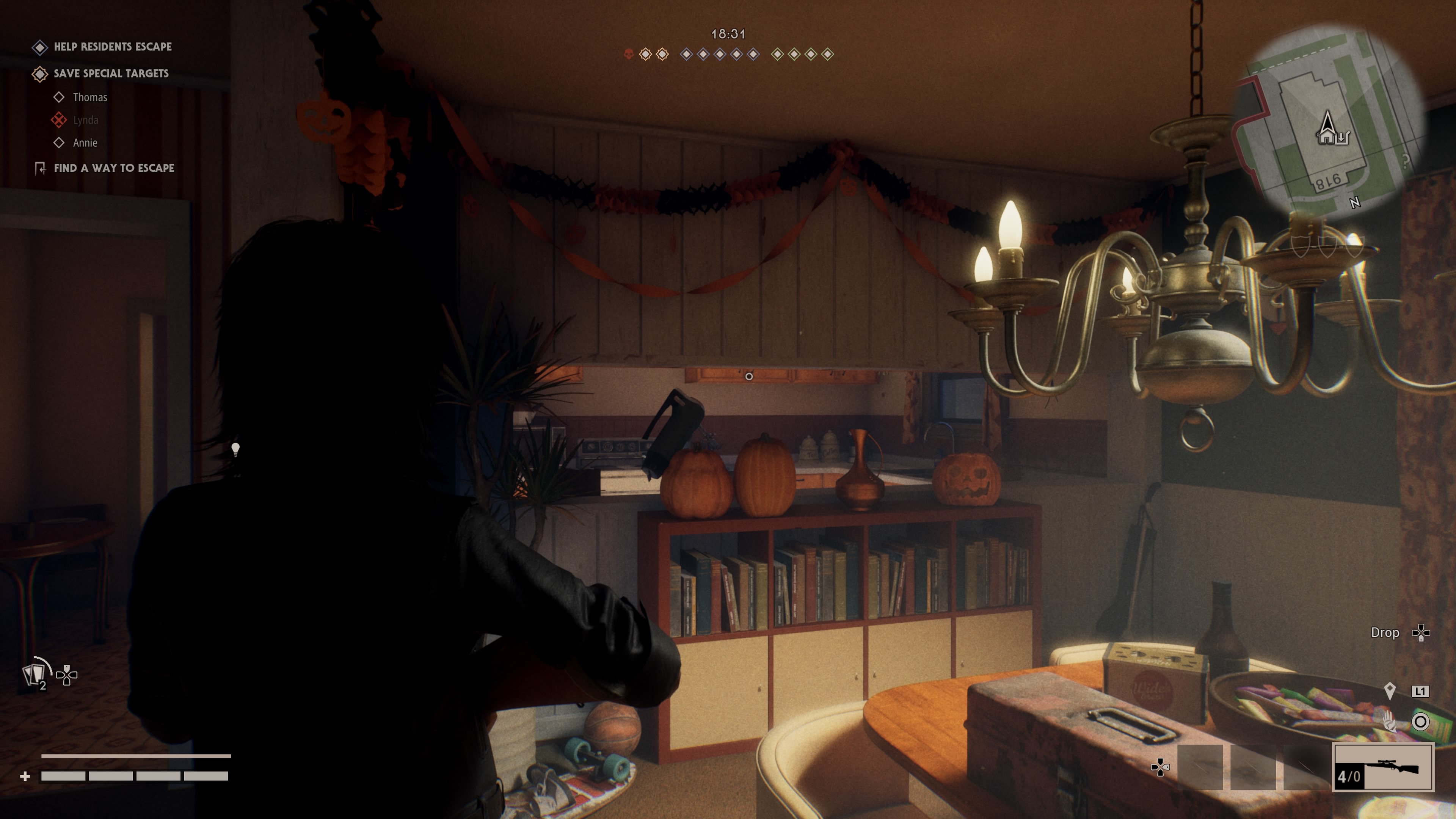
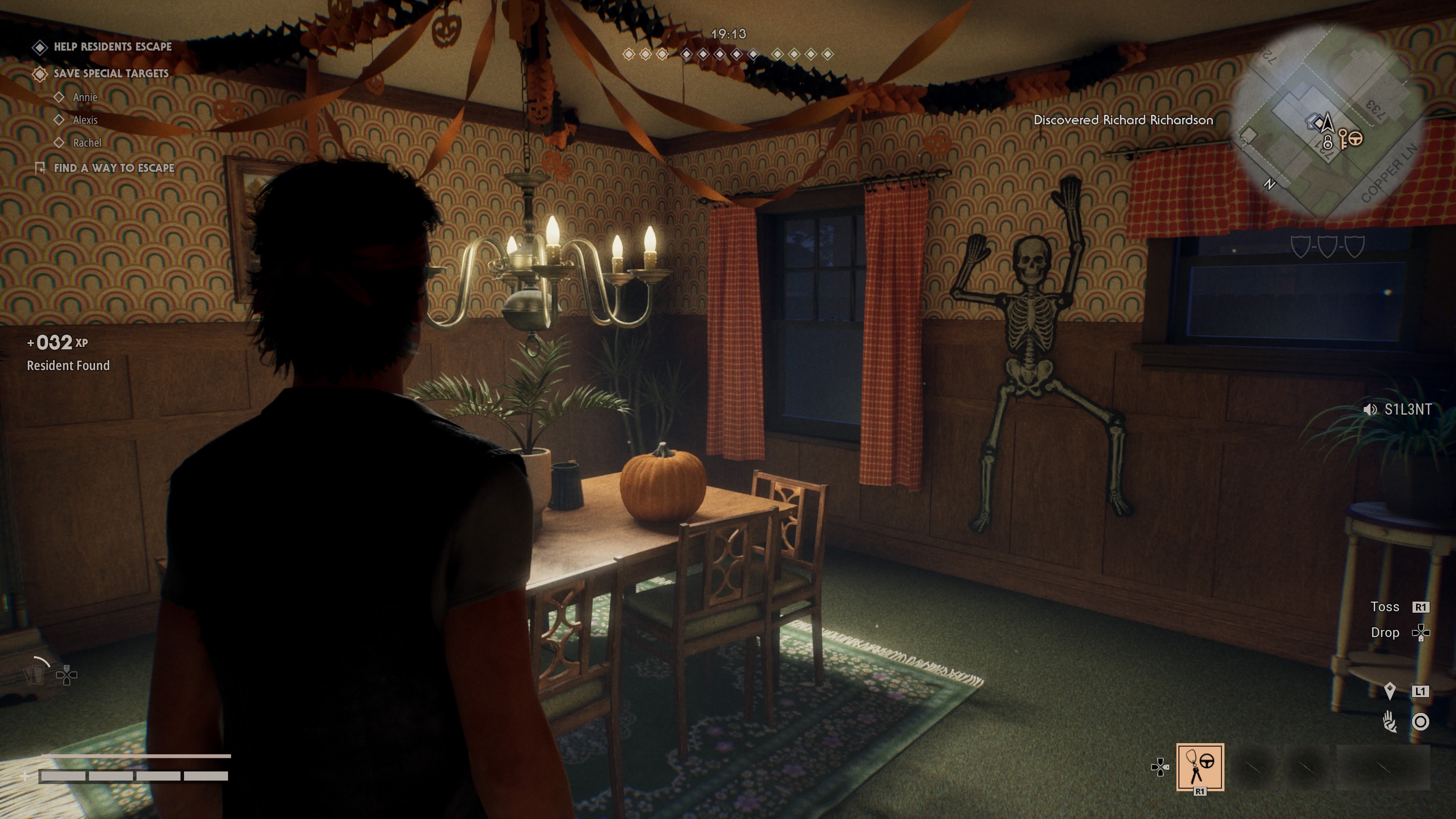


In one of my last games, I had just come out of a house and had an NPC following me when another survivor pulled up and stopped right outside in a car. I got in, the resident got in, and we all escaped. That felt good - my role was minimal, but I felt I had made a connection with another player and we had cooperated effectively toward the group goal. Now, the natural response here is "hey, you'd get that all the time if you just went on the mic!" - but I get that all the time in DbD without ever going on the mic, without being exposed to the uglier side of the gaming community. Halloween is so reliant on external communication that it's not designed to have many of these moments of connection organically.
Also: Nothing here is as good or scary as a Scratched Mirror Myers match on Lery's.
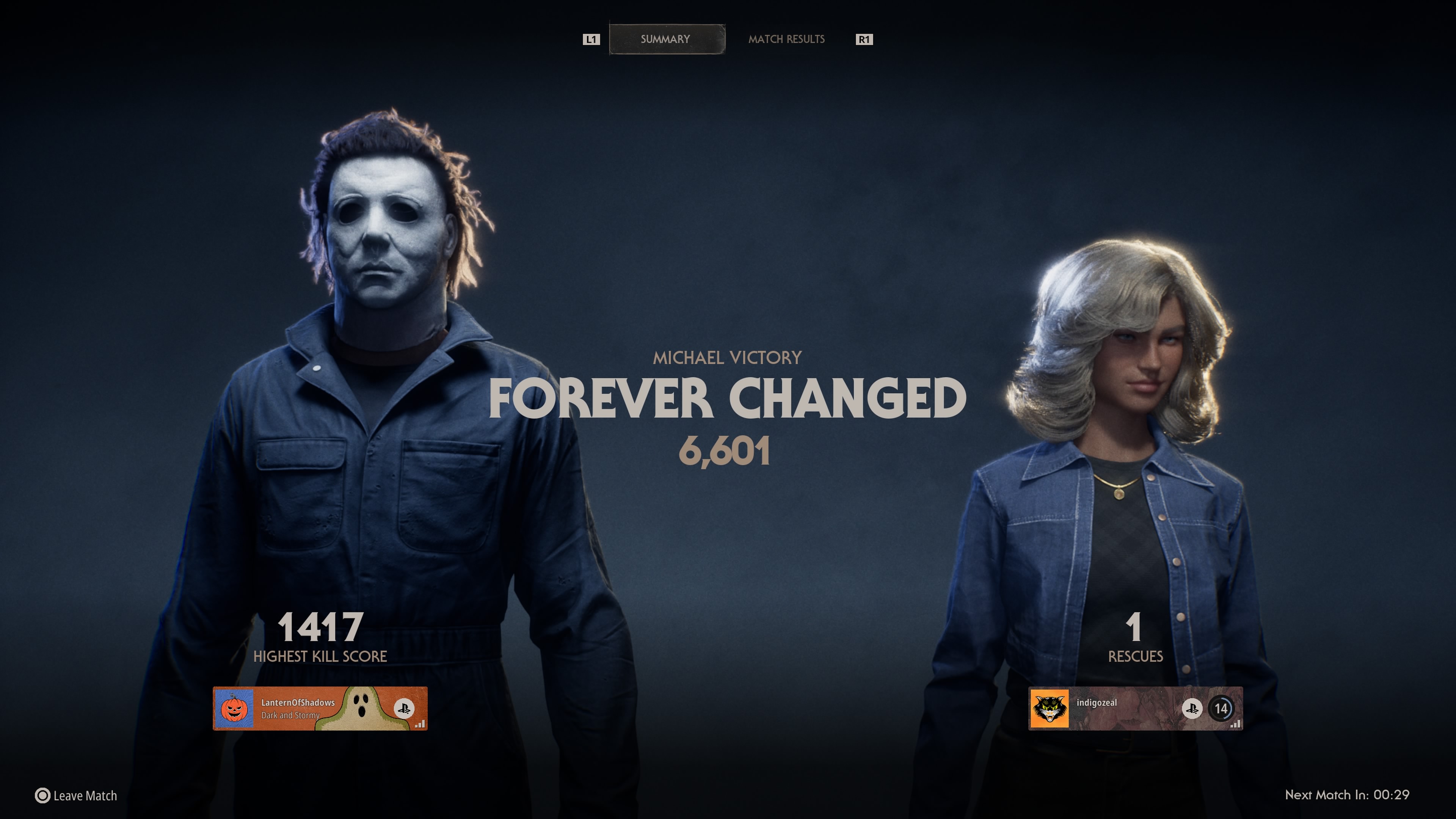
An aside: There's a good deal of discourse about DbD being an apex predator that depopulates the horror asym genre due in part to holding many (many) horror licenses instead of relying on just one, but you could make the case that Gun/Illfonic does, in fact, have a long-running multi-franchise horror asym; they just republish it every so often with a different franchise skin and updated mechanics, moving from F13 to Texas Chainsaw to Halloween now.
Page 1 of 63
